How to Start Forex Trading for Beginners with a Structured Step-by-Step Plan
You can order the same kind of articles for your own video to boost it on YouTube and Google. Just message the Telegram bot @sat_sit_bot. Articles with your video embedded are written and posted by the bot itself — on popular topical sites (no ads). Your first 50 articles are free.
· based on the channel Jeffrey Benson Forex
Key takeaways
- Forex is a decentralized market where currencies trade in pairs; the most liquid session is the London-New York overlap.
- Beginners should start with a demo account on MetaTrader 5 (MT5) and a regulated broker before risking real money.
- Risk no more than 1–2% of account equity per trade; position size is calculated from stop-loss distance.
- A basic strategy combines market structure, support/resistance, and a fixed risk-reward ratio of at least 1:2.
- Jeffrey Benson Forex offers a full beginner course and a free daily signal via Telegram.
Forex trading for beginners starts with three concrete actions: open a demo account with a regulated broker, learn one simple strategy on a single currency pair, and risk no more than 1–2% of your account per trade. You do not need a large balance or advanced indicators to begin — you need a repeatable process and strict risk control. A structured course, such as the one from Jeffrey Benson Forex, can shorten the learning curve by showing the exact tools and order types used in live trading; you can also become a student and access the full training plans.
What forex trading is and how the currency market works
Forex is the global market for exchanging national currencies, and it operates over-the-counter through a network of banks, brokers, and electronic platforms rather than a single exchange. Currencies are always quoted in pairs — EUR/USD, GBP/JPY, USD/JPY — where the first currency is the base and the second is the quote. When you buy EUR/USD, you are simultaneously buying euros and selling US dollars, profiting if the euro strengthens against the dollar.
The market runs 24 hours a day from Monday morning in Sydney to Friday evening in New York, divided into four main sessions: Sydney, Tokyo, London, and New York. Liquidity and volatility peak during the London-New York overlap, which is why many beginners focus their trading on that window. Prices move because of interest-rate decisions, inflation data, employment reports, and geopolitical events; a beginner does not need to predict news but must know when it is released to avoid unexpected slippage.
Tools and platforms every beginner needs before the first trade
A beginner needs four tools: a regulated broker, a trading platform, a charting setup, and a trading journal. The broker holds your funds and routes orders; choose one regulated by a recognized authority (FCA, ASIC, CySEC) and verify that client money is held in segregated accounts. The platform is where you place orders — MetaTrader 5 (MT5) is the industry standard for forex and supports market, limit, and stop orders, plus automated scripts.
A practical setup includes candlestick charts on the 1-hour and 4-hour timeframes, a clean price chart with support and resistance levels, and one or two indicators at most (for example, a 50-period moving average). Avoid stacking indicators before you understand price action. A trading journal — a simple spreadsheet — records the date, pair, direction, entry, stop-loss, take-profit, result, and a one-line reason for the trade; reviewing it weekly is the fastest way to find repeating mistakes.
Building a basic forex strategy foundation
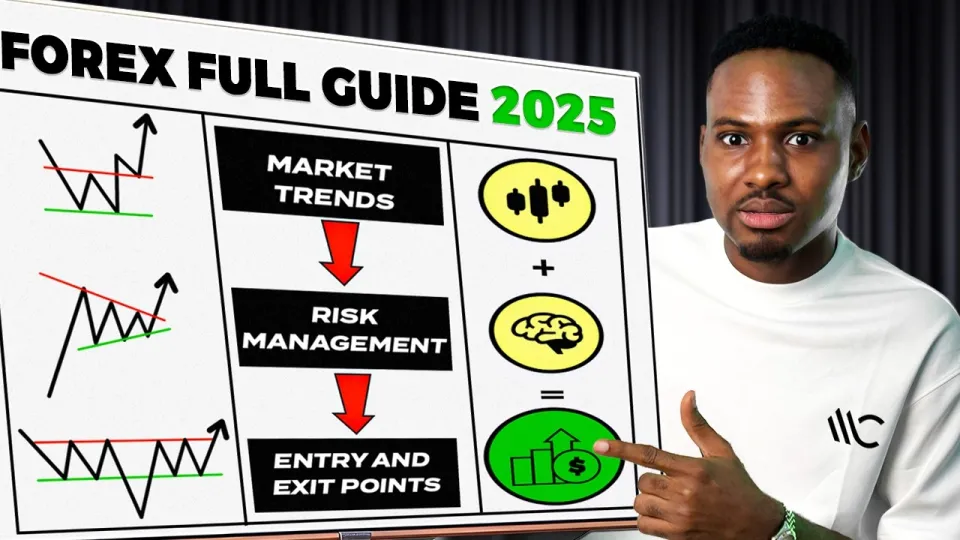
A basic forex strategy is a set of rules that tells you when to enter, where to place your stop-loss, and when to take profit — written down before you trade. Start with one pair such as EUR/USD because its spread is low and its behavior is well documented. Identify the trend on the 4-hour chart: higher highs and higher lows mean an uptrend, and you should look for buys; lower highs and lower lows mean a downtrend, and you should look for sells.
- Mark the key support and resistance zones on the 4-hour chart.
- Wait for price to return to a zone rather than chasing a breakout in the middle of nowhere.
- Confirm the entry with a candlestick pattern (pin bar, engulfing) on the 1-hour chart.
- Place the stop-loss beyond the recent swing high or low, not at an arbitrary number of pips.
- Set the take-profit at a minimum of twice the stop-loss distance (a 1:2 risk-reward ratio).
This structure forces patience: you trade only when price reaches a pre-marked level, and you know your maximum loss before clicking the button. A strategy does not need to win every trade — a 40–50% win rate with a 1:2 risk-reward ratio is profitable over a series of trades.
Placing your first trade and managing risk
Placing a first trade means calculating position size from your risk limit, not from the number of lots you feel comfortable with. If your account is $1,000 and you risk 1%, your maximum loss is $10. On EUR/USD with a 20-pip stop-loss and a standard lot where one pip equals $10, you would trade 0.05 lots (20 pips × $10 × 0.05 = $10). This calculation is the single most important habit in forex: it keeps a losing streak from wiping out your account.
On MT5, open the order ticket, select the pair, choose “Market Execution,” enter the lot size, and attach the stop-loss and take-profit before confirming. Never move a stop-loss further away to avoid being stopped out — that turns a small planned loss into a large unplanned one. Risk management also includes a daily loss limit (for example, stop trading after two losing trades) and avoiding trades during major news releases when spreads widen.
Common beginner mistakes and how to avoid them
Most beginner losses come from position sizing, not from a bad strategy. The most frequent mistakes are risking 10–20% per trade, trading without a stop-loss, revenge trading after a loss, and switching strategies every week before giving one a fair sample of 30–50 trades. Another common error is over-leveraging: leverage of 1:500 means a small price move can erase a large part of your equity, so keep effective leverage low by using small lot sizes.
Beginners also underestimate the psychological side. Trading on a demo account removes the emotional pressure of real money, which is why a gradual transition — demo, then a micro account with $100–$200 — is safer than going live with savings. Finally, avoid paying for “guaranteed profit” signals without understanding the method; a signal service can supplement learning but cannot replace it. Jeffrey Benson Forex offers a free daily signal via Telegram (https://t.me/firepipsignals) as a way to observe trade setups, but the educational foundation remains the priority.
Typical beginner questions answered from real viewer experience
Many viewers of beginner forex courses ask whether they can succeed without a large starting capital, and the answer is yes — with a micro account and strict 1% risk, a $200 account can be used to practice real execution without risking significant money. Another frequent question is how long it takes to become consistently profitable; most traders need six to twelve months of deliberate practice with a journal before results stabilize, and some need longer.
A third common concern is broker safety: check regulation, segregated funds, and withdrawal reviews before depositing, and start with a small amount to test the withdrawal process. Viewers also ask whether they should copy trades from a signal group; copying can be useful for observing how a professional manages entries and exits, but relying on it without understanding risk leads to losses when the signal provider's risk profile differs from your own account size.
Useful links
- FirePipsFX training plans and student access
- Free daily forex signal on Telegram
- Assex Markets broker registration
- Jeffrey Benson help bot for premium signals
Final thoughts on starting forex trading
Forex trading for beginners is learnable when approached as a skill built on a demo account, one simple strategy, and strict risk control rather than as a fast path to income. The sequence matters: understand how currency pairs move, set up MT5 with a regulated broker, define entry and exit rules with a 1:2 risk-reward ratio, and size every position from a 1–2% risk limit. Jeffrey Benson Forex structures this path in a full beginner course and provides a free signal channel for observation; you can review the training options and join the student plans here. Treat the first months as practice with a journal, and let consistency — not a single lucky trade — define your progress.
Questions & answers
How much money do I need to start forex trading as a beginner?
You can start with a demo account at zero cost, and a micro live account with $100–$200 is enough to practice real execution while risking only 1–2% per trade. The amount matters less than the risk percentage: a $200 account risking 1% risks $2 per trade, which is a safe learning environment.
Can I trade forex without a broker or platform?
No — retail forex trading requires a broker that provides access to the interbank market and a platform such as MetaTrader 5 to place orders. Choose a regulated broker with segregated client funds and verify withdrawal conditions before depositing.
How long does it take to become profitable in forex?
Most beginners need six to twelve months of consistent practice with a trading journal before results stabilize, and some need longer. Profitability depends on following a fixed strategy and risk limit, not on the number of indicators or hours spent watching charts.
Is copying trades from a signal group a good way to start?
Copying trades can help you observe how a professional manages entries and exits, but it does not replace understanding risk. If the signal provider risks 5% per trade and you copy with a 1% account, the outcomes will differ; use signals as a learning supplement, not as the foundation of your strategy.
Source: How To Start Forex Trading For Beginners’ 2025 (Full Course) · Markdown version